Prague’s Statues, Plaques, Street art and other Curiosities

  • The Floating Lady Vinok in Dlouha street, Prague

  • Letna park animal sculptures

  • Letna park animal sculptures

  • Statue of of Eliska Krasnohorska on Karlovo Namesti

  •                                                                                                              …

  • Where: This statue is really hard to find. It is at the end of a dead end road on Petrin Hill,  Prague 1. It is close to the statue of Jan Neruda as well as The Fountain of 2 playing boys. GPS: 50.082807, 14.400177. What: It is a statue of Ferdinand Laub. The statue depicts Laub sitting with…

  • Bust of Albert Einstein

  • The statue of Karel Hynek Macha on Petrin Hill

  • Statue called the brotherhood by Karel Pokorny

  • Where: Next to the Kampa Museum in Kampa park, Prague 1, you can find this artwork in the river Vltava. GPS: 50.084232, 14.408989 What: The artwork is called “March of the Penguins Yellow” and consists of 34 very bright yellow penguins which light up at night. The Penguins are made out of recycled plastic materials and were…

  •   Where: At Karlovo Namesti (Charles square), in Prague 2 at house number 287 and opposite of tramstop Novoměstská radnice. It is a small walk from the Palacky monument.  GPS: 50.077495, 14.419256 What: It is a plaque with a sculptured head that commemorates Dr. Václav Benda. The plaque reads; “In this house, from 1969-1999 lived and fought for…

  • Where: You can find this monument in Chotkovy sady, which is the public garden between Letna Park and the Royal garden. GPS: 50.093840, 14.408108 in Prague 1. What: As mentioned on it, this monument commemorates Julius Zeyer. It was unveiled on September 16, 1913 and was created by the sculptor Josef Mauder (December 1, 1854 – November 15,…

  •   Where: You can find these sculptures close to the Mánesův bridge at the Jan Palach Square on the Alšovo Riverbank just next to the Prague academy of Arts in Prague 1. GPS 50.088870, 14.414111 What: The artwork is named “the House of the Suicide and House of the Mother of the Suicide” and is created by…

  • Where: On Petrin Hill, in the Petrin gardens (Petřínské sady) just opposite of the statue of Jan Neruda. GPS: 50.083249, 14.402064 What: This small fountain shows two boys playing, surrounded by 6 frogs and 2 lizards. It was created in 1948 by the artist Karel Dvořák. It has been in the Petrin Gardens from 1949. The inspiration for the…

  • Where: This statue can be found in the Petrin Gardens (Petřínské sady) on Petrin Hill. It is a small walk from the Memorial to the Victims of Communism.  GPS 50.083066,14.402245 What: The statue of Jan Neruda in Petřínské sady was created by the sculptor Jan Simot and architect Karel Lapka. It was officially unveiled on the 22nd…

  • Where: The memorial of the victims of communism (in Czech: Pomník obětem komunismu) is located at the base of Petřín hill on Újezd street. GPS: 50.081164, 14.403984. What: It shows a series of originally 7 bronze statues on a flight of 26 stairs. The statue in the front is complete but with every step the statues deteriorate more…

  •   Where: Jindřicha Plachty street, in Prague 5 on building number 3. Close to Smíchovská náplavka. GPS: 50.070823, 14.409652 What: On the plaque is written: “Here lived and were arrested František Pecháček wonderful Sokol worker, commander of the resistance organisation “Jindra” and his wife Milka Pecháčková. They were tortured to death in concentration camp Mauthausen, They sacrificed there…

  •   Where: Just outside of Krizikova Metro station on Thámova street in the district of Karlin, Prague 8. GPS: 50.093237, 14.451936 What: The sculpture is named “Trialog” and the artist is Matěj Frank. It shows metal shapes of 3 people connected with pipes. The purpose of the sculpture is to be an interactive installation that invites people…

  • Where: On Arbesovo Namesti, which is in Prague 5, Smichov. GPS 50.076497, 14.405200. This is also walking distance from the bust of Frantisek Langer What: It is a statue of Jakub Arbes. It is bronze and made by Jan Černý. The ceremonial unveiling of the statue took place on the 8th of April 1964 which was exactly 50…

  • Where: If you walk on Naplavka (riverside) just look above the public toilets next to Palackého bridge (also not forget to check out the Foot). Or if you are at the start of the Palackého bridge coming from the Palackého square where you can see the Palacky monument just look down to your right. GPS: 50.073295, 14.413726 What: the statue is…

  • Where:  Below the Rašín Embankment  at Naplavka between Palackého bridge and Jiráskův bridge. GPS: 50.075085, 14.413565 and close to another sculpture called Baletka. What: The sculpture name is Noha which means foot in Czech. It was created in 2008/2009 and was placed at its current location in 2017. The Foot is made from welded tubes and is of t he…

  • Bust of Frantisek Langer

  • Where: Palackého námesti, near Palackého bridge. GPS 50.073167, 14.414865 What: This large statue is in honour of František Palacký. the construction started in 1901 and was unveiled in 1912. The bronze statues, around a sitting František represent the oppression and awakening of the people. The inscription reads “From the resurrected Nation, to its revivalist and leader” Who: František Palacký (4…

  •                                                                                          Where: At Janáčkově nábřeží 33, near the Vlatva river, close to Jiráskův bridge…

Category: Prague 1

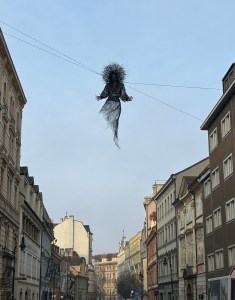
  • Dlouha street – Floating Lady Vinok

    Vonik at Dlouhá street

    Where: This artwork is hanging on Dlouha street on cables, close to the popular Roxy club and near where Dlouha street intersects with Revolucni street in Prague 1, GPS: 50.09061642330392, 14.425880902338385

    What: This artwork is on its current location from 2022 and shows a female figure with a head decoration and is named “Vinok”. She is dedicated to all mothers affected by the war in Ukraine.

    The name Vinok comes from a traditional Ukrainian headdress made of flowers. While the tradition of wearing these wreaths dates back to pre-christian Slavic times, it also in recent times became a symbol of protest during the revolution and anti-war demonstrations in Ukraine.

    The artwork is made from interconnected steel wires. The use of the materials creates a bit of a ghostly appearance, both beautiful as well as scary. By suspending it above the street, the artist wants passersby to pause and contemplate on the impact of the war and the suffering it causes for mothers.

    “Vinok” is a private undertaking by the artist, with support of her friends.

    Who: The artist’s name is Veronika Psotková (Opava, 1981). She is Czech. Most of her artworks are realistic figurative sculptures made from wires and strongly influenced by pop culture. She uses autobiographical and everyday situations themes as an inspiration. Her works often make use of the exhibition space, inside as well as outside, and becomes part of it. Her artwork has been in many national and international exhibitions.

    For more plaques, statues or street art please check the category section or search option on the home page.
  • Ostrovni street – Vojtech Hynais


    Vojrech Hynais buste

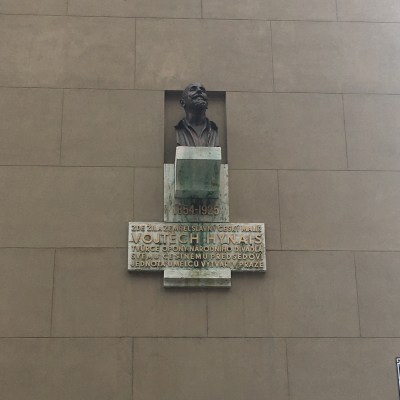
    Where: This bust with plaque is located on Ostrovni 2 in Prague 1,  right behind the National Theatre (Narodni Divaldo). GPS 50.080409, 14.414020 

    What: It is a bust with a plaque of text that commemorates Vojtech Hynais. It reads; “Here, the famous Czech painter Vojtěch Hynais lived and died, the creator of the National Theater curtain. To our Honorary Chairman from the Unity of Artists in Prague”. It was installed in 1933 and created by Jakub Obrovsky.

    Who: Vojtech Hynais (14 January 1854, Vienna – 22 August 1925, Prague) was a prominent Czech painter. He mainly painted religious and mythological images, focusing on integrating the human and the natural using particularly female nudes.  Vojtech is mostly remembered for creating a new curtain for the National Theater after the fire of 1881. The curtain celebrates the dedication of the Czech nation that was showed in rebuilding the National Theater. He also was a professor at the Prague Academy of Fine Arts. He is buried at the famous Vysehrad cemetery.

    For more plaques, statues or street art please check the category section or search option on the home page.


  • Petrin Hill – Ferdinand Laub Statue

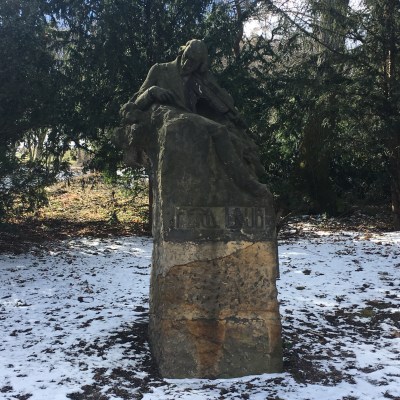
    Petrin 2Where: This statue is really hard to find. It is at the end of a dead end road on Petrin Hill,  Prague 1. It is close to the statue of Jan Neruda as well as The Fountain of 2 playing boys. GPS: 50.082807, 14.400177.
    What: It is a statue of Ferdinand Laub. The statue depicts Laub sitting with a violin in his left hand. This statue was created by Vojtěch Sapík in 1913. Originally it was located in Křivoklát, were Ferdinand had lived and moved to its current location on Petrin Hill in 1950.

    On the base of the statue there is a plaque with the text: “Ferdinand Laub world famous violinist from the famous triple stars Jos.Slavík, Ferd.Laub, Fr.Ondříček. The faithful son of the Czech nation, a friend of Bedřich Smetana, Franz Liszt, Peter Ilyich Tchaikovsky. Founder of a violin school at the Moscow Conservatory, etc. * January 19, 1832 in Prague, at Újezd (U Ježíšků) +18.3.1875 in Gries (Tyrol). Buried from 1950 in Vyšehrad”.

    Who: Ferdinand Laub (January 19, 1832 – March 17, 1875) was a famous Czech violin player. Starting with his first public appearance already at the age of six,  he was considered a well-admired violinist winning awards all over Europe. Ferdinand worked with famous musicians especially Tchaikovsky,  who dedicated String Quartet 3 to Laub after his death in 1875. Ferdinand Laub has been reburied in 1950 in the famous Vysehrad cemetery. 

  • Petrin Hill – Karel Hynek Macha

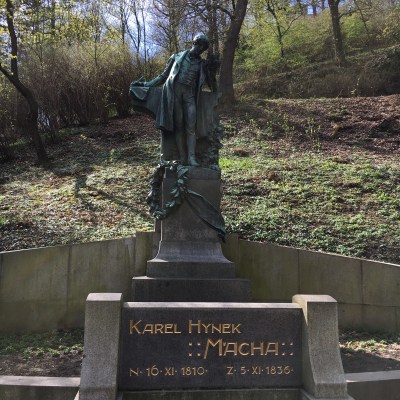
    IMG_0363Where: A bit hidden on Petrin Hill after passing the statue of Jan Neruda and the fountain of 2 playing boys in Prague 1. GPS: 50.081774, 14.401985
    What: It is a bronze statue of Karel Hynek Macha. He is standing with his right hand leaning on the wall, on which there is an open notebook and in his left hand he is holding a bouquet of lilacs. The pedestal is made of granite and the plaque mentions his name, date of his birth and of his death. The statue was created between 1910 and 1912 by Josef Václav Myslbek and Architect Antonín Balšánek

    Who: Karel Hynek Mácha (16 November 1810 – 5 November 1836) was a Czech romantic poet. His most famous poem is considered to be “Maj” (May in English) which was published shortly before his death in 1936. It is now considered to be one of the best Czech poems ever written. However recognition of his work came only after his death. Czech nationalists and academics  discovered and rehabilitated Mácha. Originally buried in a pauper grave, in 1939 his remains were exhumed, and were given a formal state burial at the famous Vyšehrad cemetery in Prague.

  • Hlavni nadrazi – Brotherhood


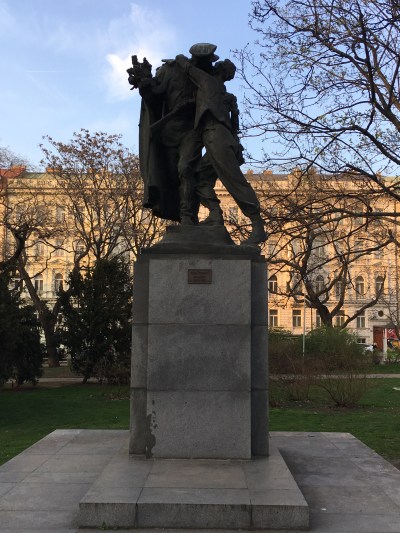
    IMG_0361Where: In the park named Vrchlického sady which is in front of Prague’s main train station (Hlavní nádraží), and really close to the Hlavní nádraží tramstops on Bolzanova street in Prague 1 ,  GPS: 50.085662, 14.435455

    What: This bronze statue is named “Brotherhood” (Sbratření) and commemorates the liberation of Czechoslovakia by the Red Army during World War II. It depicts a Czech partisan greeting a Red Army soldier with a kiss and a bouquet of lilacs.

    This statue is actually a replica of the between 1947 – 1950 created monument by Karel Pokorný.  The original you can find in the city of Ceska Trebova.  The inspiration for this statue was a picture by the Czech photographer Karel Ludwig which was made during the liberation of Prague in May 1945. 

    Who: Karel Pokorný (January 18, 1891, Pavlice – February 14, 1962, Prague) was a Czech sculptor and university professor. He was a student of Josef Vaclav Myslbek who is a prominent representative of Czech realism. As a university teacher he first worked at the Czech Technical University. Later he became a professor at the Academy of Performing Arts, were he also held the position of rector during the years 1948 to 1950.

  • Kampa park – Yellow Penguins

    IMG_0236[1]Where: Next to the Kampa Museum in Kampa park, Prague 1, you can find this artwork in the river Vltava. GPS: 50.084232, 14.408989
    What: The artwork is called “March of the Penguins Yellow” and consists of 34 very bright yellow penguins which light up at night. The Penguins are made out of recycled plastic materials and were originally part of the exhibit “RE-evolution” at Kampa Museum in 2008.

    Who: The artwork is created by a number of international artists who call themselves the Cracking Art Group. Their use of recycled plastic and bright colored animal shapes in unexpected places is to inspire a conversation about the importance and the environmental impact of recycling as well as to investigate the close relationship between natural and artificial reality.


  • Chotkovy Sady – Julius Zeyer

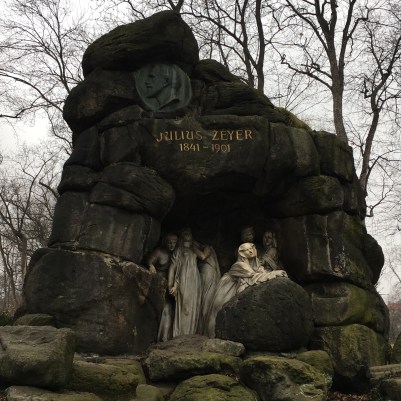
    Julius ZeyerWhere: You can find this monument in Chotkovy sady, which is the public garden between Letna Park and the Royal garden. GPS: 50.093840, 14.408108 in Prague 1.
    What: As mentioned on it, this monument commemorates Julius Zeyer. It was unveiled on September 16, 1913 and was created by the sculptor Josef Mauder (December 1, 1854 – November 15, 1920)  . The monument is in the shape of a cave which is made from granite with marble statues in it. The statues represent characters from Zeyer’s works. On the other side of the rock formation you can find a plaque with a list of those works in golden letters. 

    Who: Julius Zeyer (April 26, 1841 – January 29, 1901) was a Czech writer, playwright and Romantic poet. Two of his most famous works are the poems Vyšehrad (1880), and Karolinská epopeja (1896). In his work he often blended foreign legends and history with national themes particular to Czech society and history.  He is buried in the famous Vyšehrad cemetery in Prague.

  • Jan Palach Square – Jan Palach Memorial


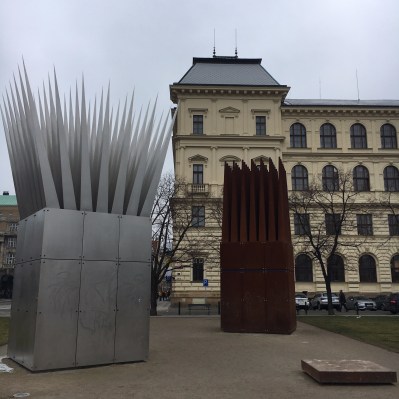
    palachWhere: You can find these sculptures close to the Mánesův bridge at the Jan Palach Square on the Alšovo Riverbank just next to the Prague academy of Arts in Prague 1. GPS 50.088870, 14.414111

    What: The artwork is named “the House of the Suicide and House of the Mother of the Suicide” and is created by the artist John Hejduk. The light statue symbolizes the figure of a son carrying light, the House of the Suicide, and the dark one a suffering mother, the House of the Mother of the Suicide. It was officially unveiled on January 16th of 2016. The artwork honors the Czech dissident Jan Palach who committed suicide by setting himself on fire as a protest against the Sovjet invasion of 1968. Besides the 2 sculptures there is a plaque with a poem written by David Shapiro called the “Funeral of Jan Palach”.

    When I entered the first meditation
        I escaped the gravity of the object,
    I experienced the emptiness,
        And I have been dead a long time.

    When I had a voice you could call a voice,
        My mother wept to me:
    My son, my beloved son,
        I never thought this possible

    I’ll follow you on foot.
        Halfway in mud and slush the microphones picked up.
    It was raining on the houses;
        It was snowing on the police-cars.

    The astronauts were weeping,
        Going neither up nor out.
    And my own mother was brave enough she looked
        And it was alright I was dead.

    Who: Jan Palach (11 August 1948 – 19 January 1969) was a Czech student of history and political economy at Charles University in Prague. After the Sovjet invasion in August of 1968, which stopped the liberalizing reforms in Czechoslovakia and thus ending the Prague Spring, Palach decided to sacrifice himself in protest of that invasion. After he had posted letters to several public figures explaining the reasons and his demands he set himself on fire on Prague’s central square (Wenceslas Square), on 16 January 1969. His funeral on the 25th of February turned into a major protest against the occupation.He is buried at Olšany Cemetery in Prague 3.


  • Petrin Hill – Fountain of 2 playing boys, Masaryk’s grandsons

    IMG_0177[1]Where: On Petrin Hill, in the Petrin gardens (Petřínské sady) just opposite of the statue of Jan Neruda. GPS: 50.083249, 14.402064

    What: This small fountain shows two boys playing, surrounded by 6 frogs and 2 lizards. It was created in 1948 by the artist Karel Dvořák. It has been in the Petrin Gardens from 1949. The inspiration for the statue of the two boys came from Herbert Revilliod, who died in an airplane crash in 1944 and Leonard Revilliod,who died because of an illness in 1945. They were the grandchildren of Thomas Masaryk, the famous first president of the Czechoslovak Republic. The statue is named Masaryks’ grandsons (Masarykovi vnuci).

    Who: Karel Dvořák (Jan 1, 1893 – Feb 28, 1950) was a Czech sculptor. He was one of the disciples of Jan Štursa, who is considered to be one of the founders of Czech modern sculpture. But in his work you can also find influences of the Italian Renaissance, Neo-classicism and baroque. Karel Dvořák’s works can be found on several locations in the Czech Republic.

  • Petrin Hill – Statue of Jan Neruda

    IMG_0179[1]Where: This statue can be found in the Petrin Gardens (Petřínské sady) on Petrin Hill. It is a small walk from the Memorial to the Victims of Communism.  GPS 50.083066,14.402245

    What: The statue of Jan Neruda in Petřínské sady was created by the sculptor Jan Simot and architect Karel Lapka. It was officially unveiled on the 22nd of October 1970.

    Who: Jan Neruda (9th of July 1834 – 22nd of August 1891) born in the Mala Strana quarter of Prague, was a Czech writer, poet and journalist. He was part of the May School, which were a group of Czech writers and poets in the 2nd half of the 19th century who focused on Czech realism and hoping to improve the status of the Czechs within the Austrian Hungarian Empire. His most famous work is considered to be Povídky malostranské (Tales of the Little Side).  This book from 1877 tells satirical stories about the Czech Bourgeois of the time and gives clear descriptions of the Mala Strana quarter. He is buried at the famous Vyšehrad Cemetery.