Jan Palach Square – Jan Palach Memorial


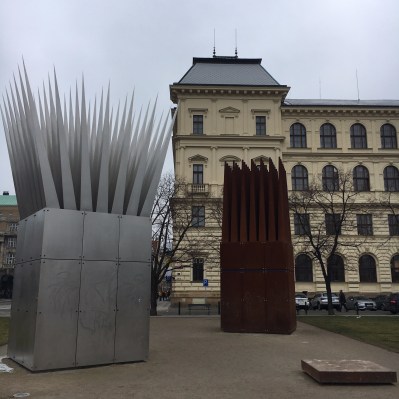
palachWhere: You can find these sculptures close to the Mánesův bridge at the Jan Palach Square on the Alšovo Riverbank just next to the Prague academy of Arts in Prague 1. GPS 50.088870, 14.414111

What: The artwork is named “the House of the Suicide and House of the Mother of the Suicide” and is created by the artist John Hejduk. The light statue symbolizes the figure of a son carrying light, the House of the Suicide, and the dark one a suffering mother, the House of the Mother of the Suicide. It was officially unveiled on January 16th of 2016. The artwork honors the Czech dissident Jan Palach who committed suicide by setting himself on fire as a protest against the Sovjet invasion of 1968. Besides the 2 sculptures there is a plaque with a poem written by David Shapiro called the “Funeral of Jan Palach”.

When I entered the first meditation
    I escaped the gravity of the object,
I experienced the emptiness,
    And I have been dead a long time.

When I had a voice you could call a voice,
    My mother wept to me:
My son, my beloved son,
    I never thought this possible

I’ll follow you on foot.
    Halfway in mud and slush the microphones picked up.
It was raining on the houses;
    It was snowing on the police-cars.

The astronauts were weeping,
    Going neither up nor out.
And my own mother was brave enough she looked
    And it was alright I was dead.

Who: Jan Palach (11 August 1948 – 19 January 1969) was a Czech student of history and political economy at Charles University in Prague. After the Sovjet invasion in August of 1968, which stopped the liberalizing reforms in Czechoslovakia and thus ending the Prague Spring, Palach decided to sacrifice himself in protest of that invasion. After he had posted letters to several public figures explaining the reasons and his demands he set himself on fire on Prague’s central square (Wenceslas Square), on 16 January 1969. His funeral on the 25th of February turned into a major protest against the occupation.He is buried at Olšany Cemetery in Prague 3.


Petrin Hill – Fountain of 2 playing boys, Masaryk’s grandsons

IMG_0177[1]Where: On Petrin Hill, in the Petrin gardens (Petřínské sady) just opposite of the statue of Jan Neruda. GPS: 50.083249, 14.402064

What: This small fountain shows two boys playing, surrounded by 6 frogs and 2 lizards. It was created in 1948 by the artist Karel Dvořák. It has been in the Petrin Gardens from 1949. The inspiration for the statue of the two boys came from Herbert Revilliod, who died in an airplane crash in 1944 and Leonard Revilliod,who died because of an illness in 1945. They were the grandchildren of Thomas Masaryk, the famous first president of the Czechoslovak Republic. The statue is named Masaryks’ grandsons (Masarykovi vnuci).

Who: Karel Dvořák (Jan 1, 1893 – Feb 28, 1950) was a Czech sculptor. He was one of the disciples of Jan Štursa, who is considered to be one of the founders of Czech modern sculpture. But in his work you can also find influences of the Italian Renaissance, Neo-classicism and baroque. Karel Dvořák’s works can be found on several locations in the Czech Republic.

Petrin Hill – Statue of Jan Neruda

IMG_0179[1]Where: This statue can be found in the Petrin Gardens (Petřínské sady) on Petrin Hill. It is a small walk from the Memorial to the Victims of Communism.  GPS 50.083066,14.402245

What: The statue of Jan Neruda in Petřínské sady was created by the sculptor Jan Simot and architect Karel Lapka. It was officially unveiled on the 22nd of October 1970.

Who: Jan Neruda (9th of July 1834 – 22nd of August 1891) born in the Mala Strana quarter of Prague, was a Czech writer, poet and journalist. He was part of the May School, which were a group of Czech writers and poets in the 2nd half of the 19th century who focused on Czech realism and hoping to improve the status of the Czechs within the Austrian Hungarian Empire. His most famous work is considered to be Povídky malostranské (Tales of the Little Side).  This book from 1877 tells satirical stories about the Czech Bourgeois of the time and gives clear descriptions of the Mala Strana quarter. He is buried at the famous Vyšehrad Cemetery.

Ujezd – Memorial to the victims of Communism

IMG_0174[1]Where: The memorial of the victims of communism (in Czech: Pomník obětem komunismu) is located at the base of Petřín hill on Újezd street. GPS: 50.081164, 14.403984.
What: It shows a series of originally 7 bronze statues on a flight of 26 stairs. The statue in the front is complete but with every step the statues deteriorate more and more. It symbolizes the suffering felt by the victims of the Communist regime. The vertical bronze strip along the center shows the estimated people impacted by communism. It reads – Victims of Communism 1948-1989:

  • 205 486 condemned
  • 248 executed
  • 4500 died in prisons
  • 327 perished at the border
  • 170 938 people emigrated.

The ceremonial unveiling of the memorial was on the 22nd of May 2002.

Who: The memorial is the work of  Czech sculptor Olbram Zoubek (21 April 1926 – 15 June 2017) and architects Jan Kerel and Zdenek Hoelzel.

J. Plachty street – Memorial plaque Frantisek and Milka


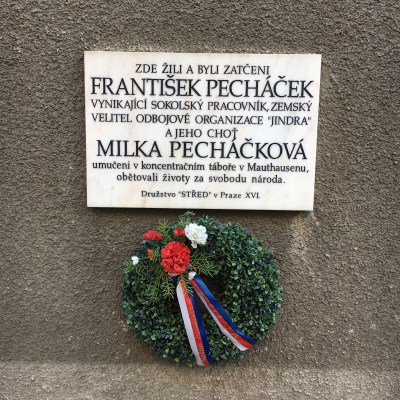
IMG_0172Where: Jindřicha Plachty street, in Prague 5 on building number 3. Close to Smíchovská náplavka. GPS: 50.070823, 14.409652

What: On the plaque is written: “Here lived and were arrested František Pecháček wonderful Sokol worker, commander of the resistance organisation “Jindra” and his wife Milka Pecháčková. They were tortured to death in concentration camp Mauthausen, They sacrificed there lives for the freedom of the nation.”

Who: František Pecháček was a Czech gymnast who competed for Czechoslovakia in the 1920 Summer Olympics. During Wold War II František and his wife Milka were members the resistance organisation called “Jindra”. Illegal meetings were held in their apartment including meetings with the paratroopers responsible for the assassination of SS Obergruppenführer Reinhard Heydrich in 1942.

As a retaliation for the successful assassination, the Nazis arrested large numbers of people who were interrogated, tortured and sent to concentration camps. František and Milka were among them. Both were arrested by the Gestapo and interrogated. Milka was later released, to hopefully lead the Gestapo to other members of the group. After she did not, she was arrested again.

The couple never met again. Both were sent to the concentration camp Mauthausen in Austria, though at different times. Milka was killed in the gas chamber on the 26th of January 1943 and František was executed om the 3rd of February 1944.


Krizikova Metro – Trialog


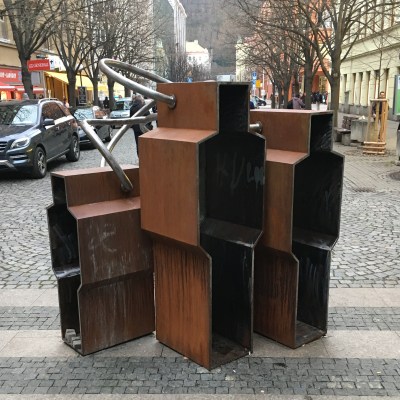
The Trialog outside metro Křižíkova station

Where: Just outside of Krizikova Metro station on Thámova street in the district of Karlin, Prague 8. GPS: 50.093237, 14.451936

What: The sculpture is named “Trialog” and the artist is Matěj Frank. It shows metal shapes of 3 people connected with pipes. The purpose of the sculpture is to be an interactive installation that invites people to test the complexity of collective communication. The sculpture was part of 2017’s  M³ festival/Art in Space in the district of Karlin.

Who: Matěj Frank born in 1989  and is a Czech artist.  In his work he deals mainly with the concept of space-time-motion-body and is also very interested in the conjunction between image and sound. Besides sculptures he is not shy to move to different forms of art like drawing, sound and performance art.


Arbesovo Namesti: Jakub Arbes

Jakub ArbesWhere: On Arbesovo Namesti, which is in Prague 5, Smichov. GPS 50.076497, 14.405200. This is also walking distance from the bust of Frantisek Langer
What: It is a statue of Jakub Arbes. It is bronze and made by Jan Černý. The ceremonial unveiling of the statue took place on the 8th of April 1964 which was exactly 50 years after his death.

Who: Jakub Arbes (12th of June 1840 – 8th of April 1914). He was a Czech writer, journalist and intellectual  and is best known for the creation of the literary genre called romanetto. In this genre stories included something which would look paranormal but which would be afterwards explained by logical reasoning. One of his most influential romanetto’s was Newtonův mozek (Newton’s Brain 1877).  Besides romanetto’s he wrote several novels.


Preslova street and namestí 14. rijna: Frantisek Langer

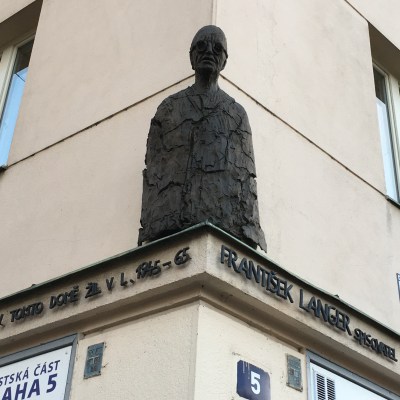
Bust Frantisek LangerWhere: On the corner of Preslova street and Náměstí 14. října (14th of October square) in Smichov, Prague 5. GPS 50.073166, 14.408125

What: It is a bust of Frantisek Langer with the text “In this house lived from 1945 to 1965 František Langer, writer”. The bust was created by Kurt Gebauer and was unveiled on the 2nd of August 1995.

Who: Frantisek Langer (3rd of March 1888 – 2nd of August 1965) was a physician and writer, and considered one of the best Czech dramatists of the interwar period.

As a physician Langer served in the Czechoslovak Legions in Russia during World War I. After the war, he served in the medical corps of the Czech army and continued his literary career. His most notable works are: Velbloud uchem jehly (1923; The Camel Through the Needle’s Eye), a comedy about lower-class life. Periferie (1925; “The Outskirts”), a psychological drama and  Jízdní hlídka (1935; “The Cavalry Watch”) which was based upon his experiences with the legion.

In 1939 Langer went to England and spent World War II as a member of the Czechoslovakian army abroad (brigade general). He only returned to his home after World War II. The postwar Communist government did not allow him to publish new work until the late 1950s.


Palackeho namesti: Palacky Monument

Frantisek Palacky monumentWhere: Palackého námesti, near Palackého bridge. GPS 50.073167, 14.414865

What: This large statue is in honour of František Palacký. the construction started in 1901 and was unveiled in 1912. The bronze statues, around a sitting František represent the oppression and awakening of the people. The inscription reads “From the resurrected Nation, to its revivalist and leader”

Who: František Palacký (4 June 1798 – 26 May 1876) was a Czech historian and politician and considered one of the most influential persons of the Czech National Revival. The purpose of this movement was to revive Czech language culture and national identity. He is one of three men honored with the title ‘Father of the Nation’, the other two being the 14th-century emperor Charles IV and the first President of Czechoslovakia Tomáš Garrigue Masaryk.

Janackove Nabrezi – Zdenek Nejedly plaque


Plaque Zdenek NejedlyWhere: At Janáčkově nábřeží 33, near the Vlatva river, close to Jiráskův bridge on the side of Smichov. GPS: 50.077748, 14.408048

What: There is a plaque with the text “Zdenek Nejedly lived in this house from May 1945 until his death in march 1962”.

Who: Zdenek Nejedly was the first Minister of Culture and Education in the early years of the Czechoslovak Socialist Republic, after 1948. His ideas have dominated the cultural life of the Czech Republic for most of the twentieth century. He is buried at Vyšehrad cemetery.