Prague’s Statues, Plaques, Street art and other Curiosities

  • The Floating Lady Vinok in Dlouha street, Prague

  • Letna park animal sculptures

  • Letna park animal sculptures

  • Statue of of Eliska Krasnohorska on Karlovo Namesti

  •                                                                                                              …

  • Where: This statue is really hard to find. It is at the end of a dead end road on Petrin Hill,  Prague 1. It is close to the statue of Jan Neruda as well as The Fountain of 2 playing boys. GPS: 50.082807, 14.400177. What: It is a statue of Ferdinand Laub. The statue depicts Laub sitting with…

  • Bust of Albert Einstein

  • The statue of Karel Hynek Macha on Petrin Hill

  • Statue called the brotherhood by Karel Pokorny

  • Where: Next to the Kampa Museum in Kampa park, Prague 1, you can find this artwork in the river Vltava. GPS: 50.084232, 14.408989 What: The artwork is called “March of the Penguins Yellow” and consists of 34 very bright yellow penguins which light up at night. The Penguins are made out of recycled plastic materials and were…

  •   Where: At Karlovo Namesti (Charles square), in Prague 2 at house number 287 and opposite of tramstop Novoměstská radnice. It is a small walk from the Palacky monument.  GPS: 50.077495, 14.419256 What: It is a plaque with a sculptured head that commemorates Dr. Václav Benda. The plaque reads; “In this house, from 1969-1999 lived and fought for…

  • Where: You can find this monument in Chotkovy sady, which is the public garden between Letna Park and the Royal garden. GPS: 50.093840, 14.408108 in Prague 1. What: As mentioned on it, this monument commemorates Julius Zeyer. It was unveiled on September 16, 1913 and was created by the sculptor Josef Mauder (December 1, 1854 – November 15,…

  •   Where: You can find these sculptures close to the Mánesův bridge at the Jan Palach Square on the Alšovo Riverbank just next to the Prague academy of Arts in Prague 1. GPS 50.088870, 14.414111 What: The artwork is named “the House of the Suicide and House of the Mother of the Suicide” and is created by…

  • Where: On Petrin Hill, in the Petrin gardens (Petřínské sady) just opposite of the statue of Jan Neruda. GPS: 50.083249, 14.402064 What: This small fountain shows two boys playing, surrounded by 6 frogs and 2 lizards. It was created in 1948 by the artist Karel Dvořák. It has been in the Petrin Gardens from 1949. The inspiration for the…

  • Where: This statue can be found in the Petrin Gardens (Petřínské sady) on Petrin Hill. It is a small walk from the Memorial to the Victims of Communism.  GPS 50.083066,14.402245 What: The statue of Jan Neruda in Petřínské sady was created by the sculptor Jan Simot and architect Karel Lapka. It was officially unveiled on the 22nd…

  • Where: The memorial of the victims of communism (in Czech: Pomník obětem komunismu) is located at the base of Petřín hill on Újezd street. GPS: 50.081164, 14.403984. What: It shows a series of originally 7 bronze statues on a flight of 26 stairs. The statue in the front is complete but with every step the statues deteriorate more…

  •   Where: Jindřicha Plachty street, in Prague 5 on building number 3. Close to Smíchovská náplavka. GPS: 50.070823, 14.409652 What: On the plaque is written: “Here lived and were arrested František Pecháček wonderful Sokol worker, commander of the resistance organisation “Jindra” and his wife Milka Pecháčková. They were tortured to death in concentration camp Mauthausen, They sacrificed there…

  •   Where: Just outside of Krizikova Metro station on Thámova street in the district of Karlin, Prague 8. GPS: 50.093237, 14.451936 What: The sculpture is named “Trialog” and the artist is Matěj Frank. It shows metal shapes of 3 people connected with pipes. The purpose of the sculpture is to be an interactive installation that invites people…

  • Where: On Arbesovo Namesti, which is in Prague 5, Smichov. GPS 50.076497, 14.405200. This is also walking distance from the bust of Frantisek Langer What: It is a statue of Jakub Arbes. It is bronze and made by Jan Černý. The ceremonial unveiling of the statue took place on the 8th of April 1964 which was exactly 50…

  • Where: If you walk on Naplavka (riverside) just look above the public toilets next to Palackého bridge (also not forget to check out the Foot). Or if you are at the start of the Palackého bridge coming from the Palackého square where you can see the Palacky monument just look down to your right. GPS: 50.073295, 14.413726 What: the statue is…

  • Where:  Below the Rašín Embankment  at Naplavka between Palackého bridge and Jiráskův bridge. GPS: 50.075085, 14.413565 and close to another sculpture called Baletka. What: The sculpture name is Noha which means foot in Czech. It was created in 2008/2009 and was placed at its current location in 2017. The Foot is made from welded tubes and is of t he…

  • Bust of Frantisek Langer

  • Where: Palackého námesti, near Palackého bridge. GPS 50.073167, 14.414865 What: This large statue is in honour of František Palacký. the construction started in 1901 and was unveiled in 1912. The bronze statues, around a sitting František represent the oppression and awakening of the people. The inscription reads “From the resurrected Nation, to its revivalist and leader” Who: František Palacký (4…

  •                                                                                          Where: At Janáčkově nábřeží 33, near the Vlatva river, close to Jiráskův bridge…

Tag: bust

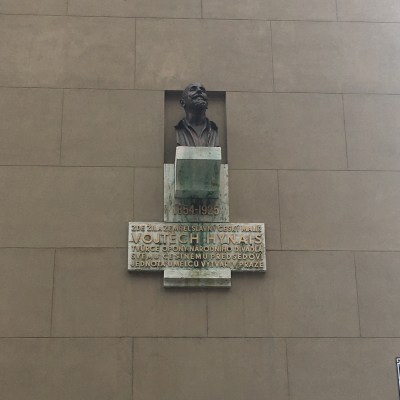
  • Ostrovni street – Vojtech Hynais


    Vojrech Hynais buste

    Where: This bust with plaque is located on Ostrovni 2 in Prague 1,  right behind the National Theatre (Narodni Divaldo). GPS 50.080409, 14.414020 

    What: It is a bust with a plaque of text that commemorates Vojtech Hynais. It reads; “Here, the famous Czech painter Vojtěch Hynais lived and died, the creator of the National Theater curtain. To our Honorary Chairman from the Unity of Artists in Prague”. It was installed in 1933 and created by Jakub Obrovsky.

    Who: Vojtech Hynais (14 January 1854, Vienna – 22 August 1925, Prague) was a prominent Czech painter. He mainly painted religious and mythological images, focusing on integrating the human and the natural using particularly female nudes.  Vojtech is mostly remembered for creating a new curtain for the National Theater after the fire of 1881. The curtain celebrates the dedication of the Czech nation that was showed in rebuilding the National Theater. He also was a professor at the Prague Academy of Fine Arts. He is buried at the famous Vysehrad cemetery.

    For more plaques, statues or street art please check the category section or search option on the home page.
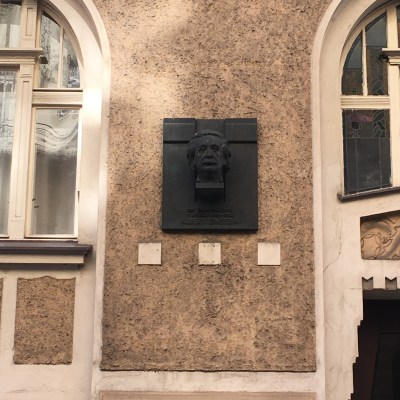
     

  • Lesnicka street – Albert Einstein

    LesnickaWhere: This bust is located on Lesnicka street number 7 in Prague 5 . This street is between the Jiraskuv and Palackeho bridges . GPS: 50.073837, 14.408589
    What: It is a bust of the famous scientist Albert Einstein. The text below the bust reads “Here lived and worked in 1911-1912 Albert Einstein” The bust was unveiled on the 13th of March 1979.

    Who: Albert Einstein (14th of March 1879 – 18th of  April 1955) was a German-born theoretical physicist who is most famous for developing the theory of relativity, one of the two pillars of modern physics. Already the author of this Theory,  Einstein moved in April of 1911 to Prague where he was appointed as the professor of theoretical physics at Prague’s Charles University. He worked and lived in Prague only for 16 months. In July of 1912 he accepted the chair of theoretical physics at the Polytechnical Institute of Zurich in Switzerland. This ended his stay in Prague.

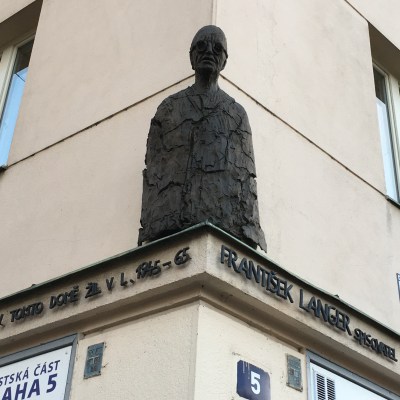
  • Preslova street and namestí 14. rijna: Frantisek Langer

    Bust Frantisek LangerWhere: On the corner of Preslova street and Náměstí 14. října (14th of October square) in Smichov, Prague 5. GPS 50.073166, 14.408125

    What: It is a bust of Frantisek Langer with the text “In this house lived from 1945 to 1965 František Langer, writer”. The bust was created by Kurt Gebauer and was unveiled on the 2nd of August 1995.

    Who: Frantisek Langer (3rd of March 1888 – 2nd of August 1965) was a physician and writer, and considered one of the best Czech dramatists of the interwar period.

    As a physician Langer served in the Czechoslovak Legions in Russia during World War I. After the war, he served in the medical corps of the Czech army and continued his literary career. His most notable works are: Velbloud uchem jehly (1923; The Camel Through the Needle’s Eye), a comedy about lower-class life. Periferie (1925; “The Outskirts”), a psychological drama and  Jízdní hlídka (1935; “The Cavalry Watch”) which was based upon his experiences with the legion.

    In 1939 Langer went to England and spent World War II as a member of the Czechoslovakian army abroad (brigade general). He only returned to his home after World War II. The postwar Communist government did not allow him to publish new work until the late 1950s.