
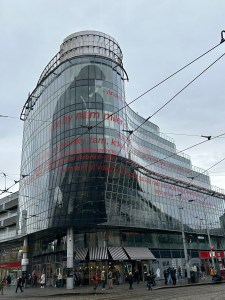
 Where: This building is hard to miss; on the right side of the Vltava, you can find it above the “Anděl” metro station, next to the tram stops with the same name and directly opposite of the Novy Smichov shopping center in the Smichov district of Prague 5.
GPS: 50°04’19.0″N 14°24’14.1″E
What: Zlatý Anděl or Golden Angel is a building that was finalized in 2001. It functions as a multi complex with a shopping mall, commercial and office spaces. The most eye-catching aspect of the building is the shape of the glass façade with a picture of a man and red text.
The man depicts an eighteen-metre-high figure of an angel looking down from the sky onto the tramline crossroads. The figure is inspired by Wim Wenders’ 1987 movie about immortal angels “Der Himmel über Berlin” (Wings of Desire).
The red texts are excerpts from the works of Jaroslav Seifert, Franz Kafka, Gustav Meyrink, Jiří Orten and Rainer Maria Rilke, who all have a connection with Prague.
Both the image of the angel and the text are supposed to symbolize the birth of the building. The Golden Angel’s name comes from the well-known Lékárna U Zlatého Anděla or The Golden Angel’s Pharmacy, this building stood on the same spot but was demolished in 1980 to make room for the new Andel metro station.
According to the architect the figure and the text are a continuation of the building tradition of Prague with its painted and written facades.
Who: The architect’s name is Jean Nouvel, born in Fumel, France in 1945. He is a renowned architect whose building designs you can see across the globe. Nouvel’s designs are modern and he places enormous importance on designing a building that is harmonious with its surroundings.
For more plaques, statues or street art please check the category section or search option on the home page
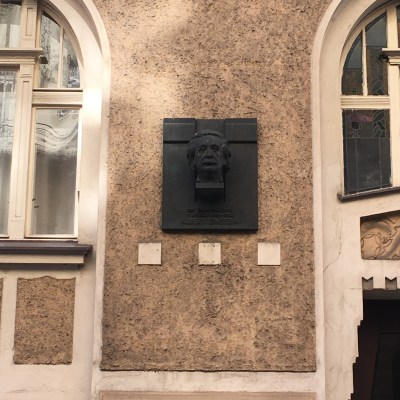 Where: This bust is located on Lesnicka street number 7 in
 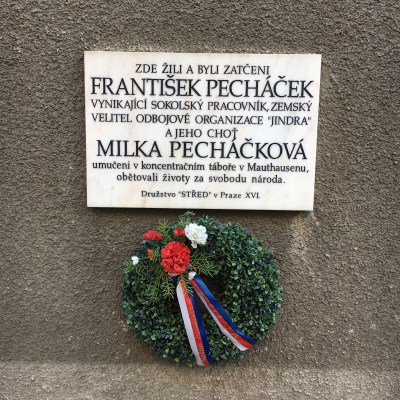 Where: Jindřicha Plachty street, in
  Prague's Statues, Plaques, Street art and other curiosities