Featured

Karlovo Namesti – Eliska Krasnohorska

IMG_0259[1]Where: This statue is located on Karlovo Namesti (Charles Square) in Prague 2 near one of the entrances to the metro line and the tram stop. GPS: 50.075965, 14.419597

What: It is a statue of Eliška Krásnohorská and was unveiled in 1931. The autor of the statue is Karla Vobišová-Žáková. The monument is carved from a single block of white marble. It depicts, a slightly larger then in life,  Eliška Krásnohorská standing in a dress with a cape tied at her neck holding a scroll of papers. She is standing on a small pedestal which has the inscription Eliška Krásnohorská.

Who: Eliška Krásnohorská (18th of November 1847 – 26th of November 1926) was a Czech author and  a pioneer of the women’s movement.  She wrote works of lyric poetry and literary criticism, however, she is usually associated with children’s literature and translations. In 1890 she founded the Minerva School in Prague. This was the first gymnasium for girls in Austria Hungary and its language of instruction was Czech.

For more plaques, statues or street art please check the category section or search option on the home page
 

Featured

Petrin Hill – Ferdinand Laub Statue

Petrin 2Where: This statue is really hard to find. It is at the end of a dead end road on Petrin Hill,  Prague 1. It is close to the statue of Jan Neruda as well as The Fountain of 2 playing boys. GPS: 50.082807, 14.400177.
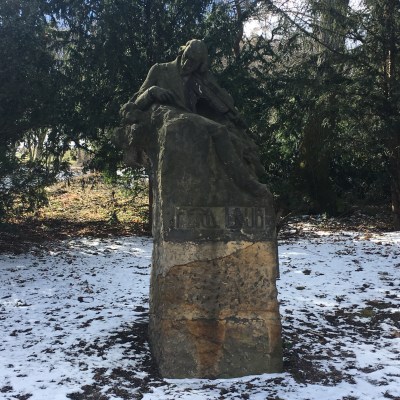
What: It is a statue of Ferdinand Laub. The statue depicts Laub sitting with a violin in his left hand. This statue was created by Vojtěch Sapík in 1913. Originally it was located in Křivoklát, were Ferdinand had lived and moved to its current location on Petrin Hill in 1950.

On the base of the statue there is a plaque with the text: “Ferdinand Laub world famous violinist from the famous triple stars Jos.Slavík, Ferd.Laub, Fr.Ondříček. The faithful son of the Czech nation, a friend of Bedřich Smetana, Franz Liszt, Peter Ilyich Tchaikovsky. Founder of a violin school at the Moscow Conservatory, etc. * January 19, 1832 in Prague, at Újezd (U Ježíšků) +18.3.1875 in Gries (Tyrol). Buried from 1950 in Vyšehrad”.

Who: Ferdinand Laub (January 19, 1832 – March 17, 1875) was a famous Czech violin player. Starting with his first public appearance already at the age of six,  he was considered a well-admired violinist winning awards all over Europe. Ferdinand worked with famous musicians especially Tchaikovsky,  who dedicated String Quartet 3 to Laub after his death in 1875. Ferdinand Laub has been reburied in 1950 in the famous Vysehrad cemetery. 

Featured

Hlavni nadrazi – Brotherhood


IMG_0361Where: In the park named Vrchlického sady which is in front of Prague’s main train station (Hlavní nádraží), and really close to the Hlavní nádraží tramstops on Bolzanova street in Prague 1 ,  GPS: 50.085662, 14.435455

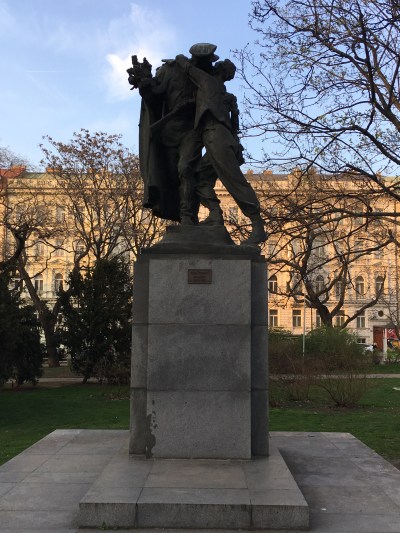
What: This bronze statue is named “Brotherhood” (Sbratření) and commemorates the liberation of Czechoslovakia by the Red Army during World War II. It depicts a Czech partisan greeting a Red Army soldier with a kiss and a bouquet of lilacs.

This statue is actually a replica of the between 1947 – 1950 created monument by Karel Pokorný.  The original you can find in the city of Ceska Trebova.  The inspiration for this statue was a picture by the Czech photographer Karel Ludwig which was made during the liberation of Prague in May 1945. 

Who: Karel Pokorný (January 18, 1891, Pavlice – February 14, 1962, Prague) was a Czech sculptor and university professor. He was a student of Josef Vaclav Myslbek who is a prominent representative of Czech realism. As a university teacher he first worked at the Czech Technical University. Later he became a professor at the Academy of Performing Arts, were he also held the position of rector during the years 1948 to 1950.

Featured

Petrin Hill – Statue of Jan Neruda

IMG_0179[1]Where: This statue can be found in the Petrin Gardens (Petřínské sady) on Petrin Hill. It is a small walk from the Memorial to the Victims of Communism.  GPS 50.083066,14.402245
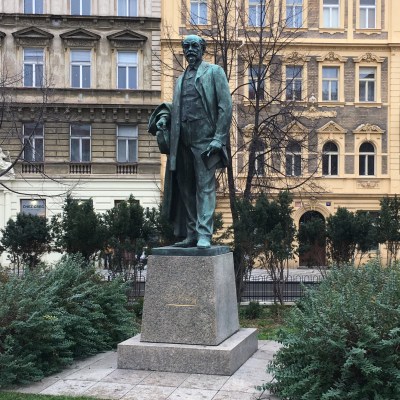
What: The statue of Jan Neruda in Petřínské sady was created by the sculptor Jan Simot and architect Karel Lapka. It was officially unveiled on the 22nd of October 1970.

Who: Jan Neruda (9th of July 1834 – 22nd of August 1891) born in the Mala Strana quarter of Prague, was a Czech writer, poet and journalist. He was part of the May School, which were a group of Czech writers and poets in the 2nd half of the 19th century who focused on Czech realism and hoping to improve the status of the Czechs within the Austrian Hungarian Empire. His most famous work is considered to be Povídky malostranské (Tales of the Little Side).  This book from 1877 tells satirical stories about the Czech Bourgeois of the time and gives clear descriptions of the Mala Strana quarter. He is buried at the famous Vyšehrad Cemetery.
Featured

Arbesovo Namesti: Jakub Arbes

Jakub ArbesWhere: On Arbesovo Namesti, which is in Prague 5, Smichov. GPS 50.076497, 14.405200. This is also walking distance from the bust of Frantisek Langer
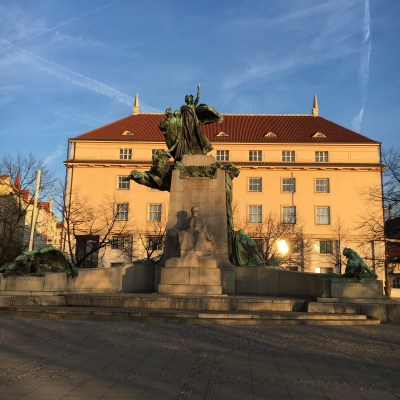
What: It is a statue of Jakub Arbes. It is bronze and made by Jan Černý. The ceremonial unveiling of the statue took place on the 8th of April 1964 which was exactly 50 years after his death.

Who: Jakub Arbes (12th of June 1840 – 8th of April 1914). He was a Czech writer, journalist and intellectual  and is best known for the creation of the literary genre called romanetto. In this genre stories included something which would look paranormal but which would be afterwards explained by logical reasoning. One of his most influential romanetto’s was Newtonův mozek (Newton’s Brain 1877).  Besides romanetto’s he wrote several novels.


Palackeho namesti: Palacky Monument

Frantisek Palacky monumentWhere: Palackého námesti, near Palackého bridge. GPS 50.073167, 14.414865

What: This large statue is in honour of František Palacký. the construction started in 1901 and was unveiled in 1912. The bronze statues, around a sitting František represent the oppression and awakening of the people. The inscription reads “From the resurrected Nation, to its revivalist and leader”

Who: František Palacký (4 June 1798 – 26 May 1876) was a Czech historian and politician and considered one of the most influential persons of the Czech National Revival. The purpose of this movement was to revive Czech language culture and national identity. He is one of three men honored with the title ‘Father of the Nation’, the other two being the 14th-century emperor Charles IV and the first President of Czechoslovakia Tomáš Garrigue Masaryk.