
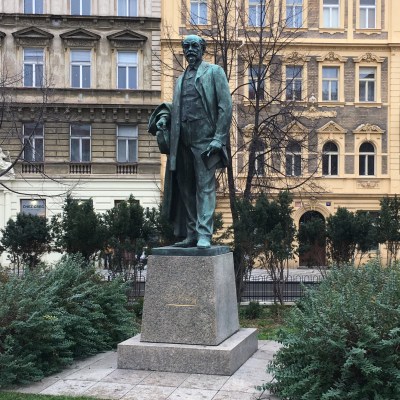
 Where: On Arbesovo Namesti, which is in Prague 5, Smichov. GPS 50.076497, 14.405200. This is also walking distance from the bust of Frantisek Langer
What: It is a statue of Jakub Arbes. It is bronze and made by Jan Černý. The ceremonial unveiling of the statue took place on the 8th of April 1964 which was exactly 50 years after his death.
Who: Jakub Arbes (12th of June 1840 – 8th of April 1914). He was a Czech writer, journalist and intellectual and is best known for the creation of the literary genre called romanetto. In this genre stories included something which would look paranormal but which would be afterwards explained by logical reasoning. One of his most influential romanetto’s was Newtonův mozek (Newton’s Brain 1877). Besides romanetto’s he wrote several novels.
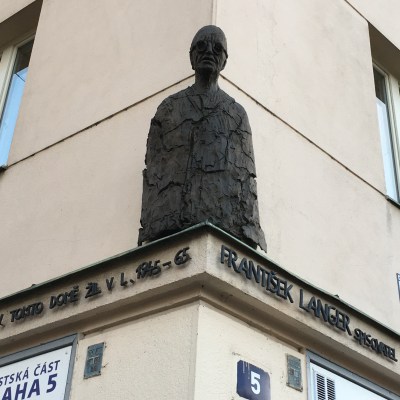 Where: On the corner of Preslova street and Náměstí 14. října (14th of October square) in Smichov, Prague 5. GPS
  Prague's Statues, Plaques, Street art and other curiosities